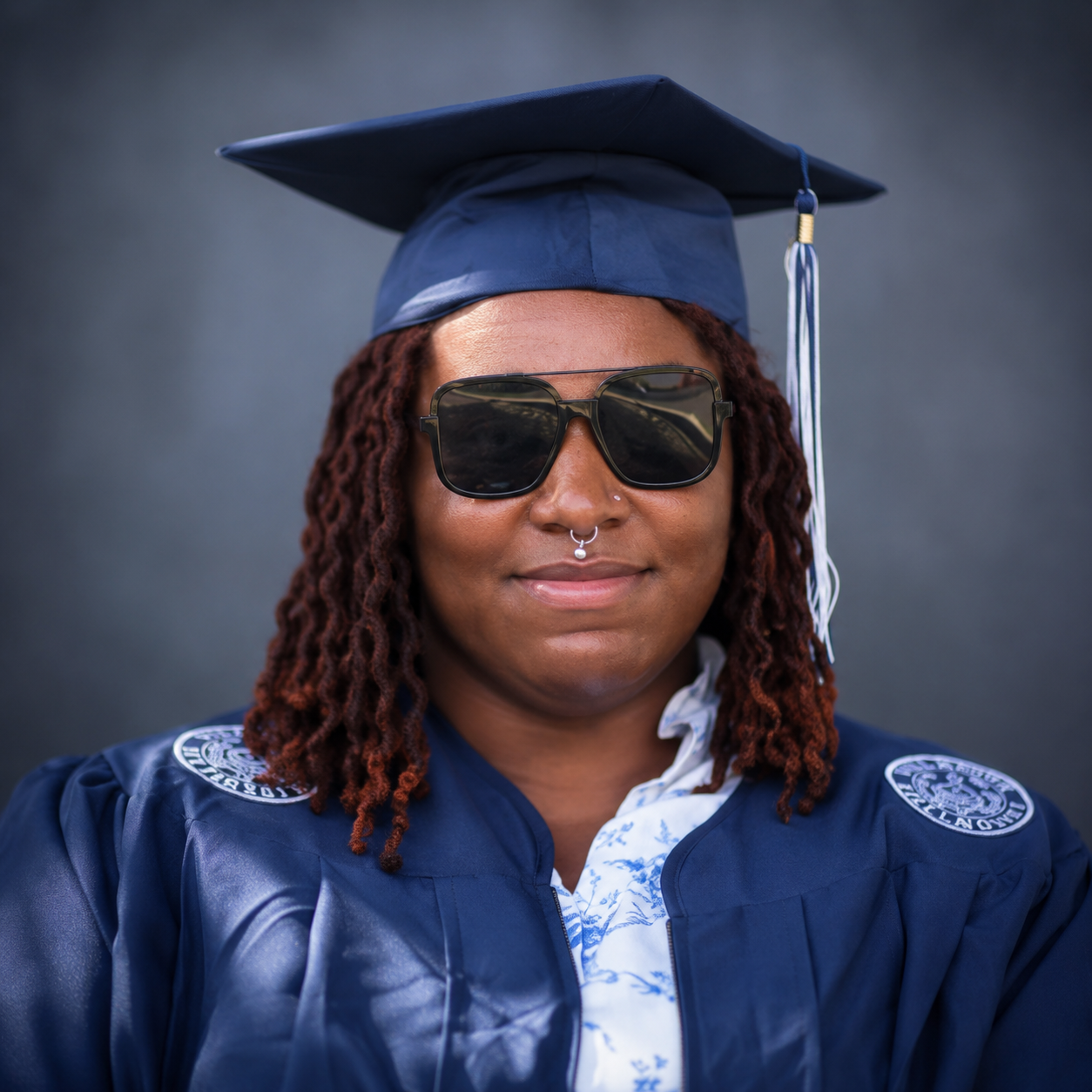
How My MBA Accidentally Rewired My Brain
An MBA, neurodiversity, and the surprisingly useful art of understanding systems.
Corporate America, historically, isn’t the kindest space for neurodivergent people. It is a machine that was built without us in mind—admittedly, it was a system built without anyone but a neurotypical, white, cisgender male in mind, but that is a discussion for another time.
Thus, earning an MBA as a neurodivergent is definitely something one could define as an interesting choice. For me, I always knew I wanted to go to grad school. I really just struggled with what degree I wanted to earn. I’m an English major, so at one point I was thinking about getting an MFA in Creative Writing or maybe a Masters in Communications or Journalism. Then, when I started working in Non-Profits, I considered (and almost applied to) MPA programs. Then I considered an MS in Data Science.

How I landed on receiving my MBA was very anticlimactic, from my perspective. I work at a university, which means one of my benefits as an employee is tuition remission. There is a certain expectation that you are going to earn a degree, because it is considered part of your benefits package in a way. Thus, it’s very rare for an employee to get rejected. So a lot of the fear of rejection and anticipation about waiting for a decision didn’t exist for me. In addition, since I never really had a specific “dream” graduate degree, I never had my heart set on a degree, but rather just wanted to get something that furthered my education and helped me get to the next step career-wise.
From “I don’t belong here” to “That wasn’t so bad”
The factors that went into landing on the MBA were that I wanted a versatile degree that would give me the most bang for my buck, give me a clear pathway in terms of resources to pivot my career into something within the realm of analytics, and be a degree that could increase my earning potential. Thus, upon much reflection and googling about the average salary increase post-graduation, I landed on an MBA with specializations in Analytics and Applied Artificial Intelligence, and Machine Learning.
As a liberal arts major in undergrad, I had a lot of initial imposter syndrome my first semester in classes with predominantly business professionals and engineers. I remember writing my first discussion post for one of my first classes. There was this intense, borderline overwhelming agitation that was festering inside of me. I was just ruminating over this thought of, You don’t belong here. You will never belong in the Corporate Landscape. Why are you in these classes getting a business degree? What’s wrong with you?
The stress of my own thoughts was all-consuming and just taking over my senses to the point that an arguably very simple discussion post and response assignment left me feeling like I wrote a 10-page essay.
At around the halfway point in my first semester, those feelings faded. By that point, I was two classes into the program and realized that everyone in my classes was also stumbling and vibing their way through business. The program itself was a lot easier than I thought it would be, especially comparing my experience to other graduate students I saw on TikTok during finals week. In my point of view, the material was not intense and the workload was manageable. The hardest part might have been juggling being a normal functioning adult with being a student.
An MBA, essentially, really is just learning how to business at the highest level of business one could possibly business. It teaches you to eat, sleep, and breathe business. When you finally have an MBA, you essentially become business.

Neurodivergent brains like systems
My flavor of neurodiversity is that I like to understand systems. Understanding and making sense of systems is how I am able to best determine how I will move, interact, and engage. It also helps me identify the bare minimum I need to do on days when I am low on spoons. Thus, the practical aspect of learning how to business was both helpful for me as someone with a liberal arts background but also someone who is neurodivergent.
I gained strategies or tips for negotiating, engaging in power and politics at the workplace, and ways to gain and leverage influence to my advantage. These are the skills that make surviving and thriving in the corporate world easier for everyone, but especially for those of us who are neurodivergent.
Critical Thinking and Strategy are the biggest parts of the MBA. You need to be able to analyze and assess a problem with little information and think strategically about how to solve the problem. This is something that is incredibly hard to teach, but I think it is something that neurodiverse individuals innately accelerate. We like pulling apart problems, we are really good at assessing situations, and we like thinking!
My biggest struggle has been that my neurodivergent brain makes me think very rigidly. I was always overly concerned with getting the right answer. I would fixate on getting the right answer to the point of frustration. Something that somewhat helped me work through this was doing case analyses.
Giving up on “being right”
Case analysis starts with receiving a scenario. From that scenario, you have to define the problem and propose a solution to the problem using the information given and sometimes outside sources.
What I came to learn is that the answer didn’t matter.
What mattered was the ability to quickly assess a situation, define what needs to be solved and why, propose a solution, and be able to defend that. In the beginning, this was so hard for me. Post Grad? It’s still hard but decidedly easier. But what makes it easier for me is that I force myself to do this personally and professionally.

This skill I learned getting my MBA has helped me navigate and combat my rigid thinking more so than any therapy or any exercise because of the fact that I have this framework.
It has also really forced me to own my decisions and be confident in them, which is something I really struggled with as well. And, to me, there is a certain level of cartoonish irony that I learned this skill WHILE OBTAINING AN MBA. Which was the last place I ever expected to learn any type of coping mechanism to combat my lizard brain and make it more efficient.
At the beginning of my MBA journey, I wasn’t entirely sure what exactly I was going to gain. I knew it was going to be something, but wasn’t entirely sure what. But I think walking away with an understanding of business as a system, how I can best participate in the system as a neurodivergent individual, gaining understanding of how to think critically and make strategic decisions both professionally and personally, and being recognized as an individual with professional credentials that can be taken away are all pretty cool things to walk away with.