Your Personal Monthly Review: Tipping the scales toward growth
You know that cheesy song from Rent, “Seasons of Love”? I had to sing it in 8th grade chorus, so the lyrics are now trapped forever within the recesses of my brain. It asks how you “measure a year in the life” – and for me, performing a personal monthly review helps me do just that.
A lot of ADHDers experience time blindness. The panicked feeling when I think to myself, We're at the end of another month? Already?! can fill me with dread. Did I use my time wisely, or did I waste it all? Did I make intentional effort or progress on my goals? What occasions derailed me or caused plans to change? If I look at how I spent my time, will I be proud of the results, or will it merely show an alarmingly high number of nights, doom-scrolling on the couch? (Again.)

This tool can be used to assess time, evaluate and implement time management strategies, and realign with desired goals and outcomes – but it shouldn't be used to punish yourself. The point is not to optimize every moment of my life (because I refuse to succumb to extractive capitalism) but to remember and validate what holds value for me – like spending time with friends, enjoying new experiences, and practicing self-care. Customize it to suit your needs.
So how does this whole thing work? For my monthly review, I created a rubric to evaluate different areas of my life by category. I assign a score, on a scale of 1-10, for each category based on criteria that is clear but flexible, so it can flow from month to month. Some folks don't want to be boxed in and prefer to assign a score based on vibes – if that sounds like you, do what makes your heart sing. Also, if a monthly rating feels like rating your life every time you turn around, a quarterly scorecard is a good alternative.
Here are a couple of layout ideas for visualizing your monthly or quarterly review:
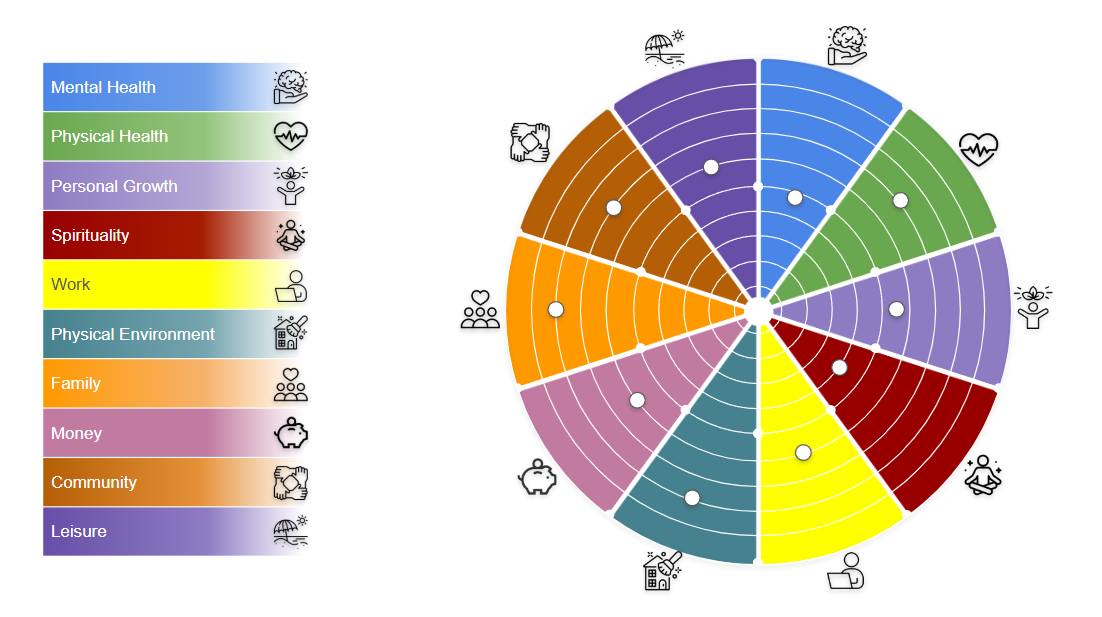
The life pie
Create a pie chart with equal sections for however many aspects of your life you want to track. Each time you do your review, place a dot to indicate how “full” each slice is.
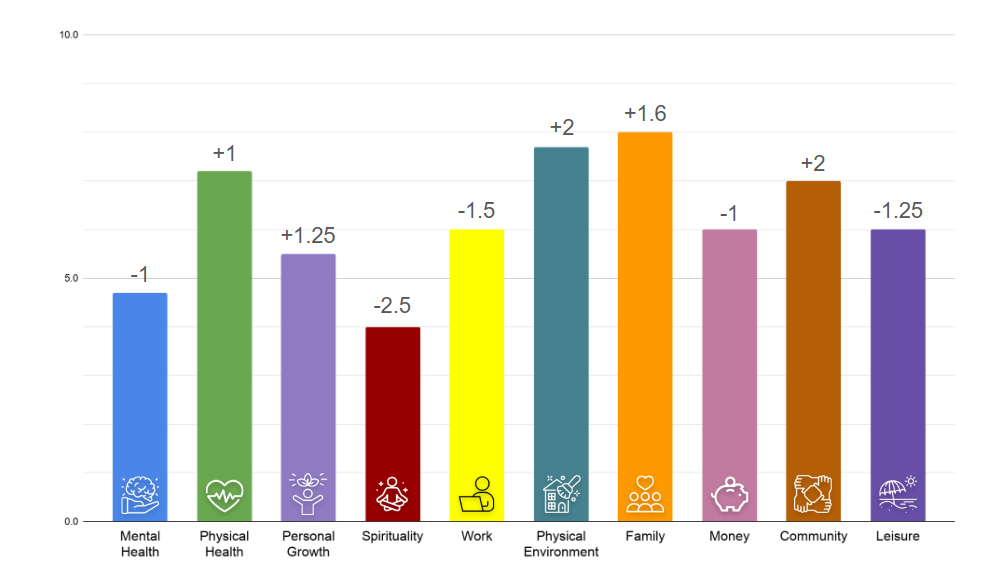
The bar graph
You can also use a more simple bar graph if that works better for you!

What to track
You don’t have to use my exact categories! You can track anything that matters to you. Some common places to start include:
Health
Friends & Family/Community
Partner Relationship
Finances/Budget
Personal Growth/Self Actualization
Home Environment
Work/Career
Special Interest/Focused Project (reading, decluttering, crafting, starting a business, your fave hobby, etc.)
If you do want to establish criteria for a category, the world is your oyster. I've got big Taurus energy so I tend toward concrete, tangible examples: how many workouts did I complete? How many therapy sessions did I have? But some of my values are more qualitative: did I spend time in nature? Did I play with and snuggle my cats? Did I experience awe and wonder?
As you're coming up with your own standards, consider what makes you feel happy, healthy, safe, or confident. Or if you're hyping up other values and want to sprout out of your comfort zone, ask what makes you feel creative, sexy, powerful, collaborative, like your quirky alter ego? These are great guideposts to frame your review.
Tools to help you prepare for a monthly review
Look at photos, your calendar, or receipts/bank statements to inform how you spent your month. You could also consider things like how many games/hours you played, how many books you read, how many social dates you had, how many art projects you started, worked on, or completed, how many miles you put on your car, or anything else that holds significance to you.

For my category criteria, I created statements relevant to what matters to me in that area of life. I try to base my rating off of the evidence of things that happened, because otherwise, my inner critic can be pretty judgmental and tries to tell me that I didn’t do enough. Looking at my calendar and camera roll really help me remember what actually transpired. “Oh, yeah – looking at these photos reminds me that I went for three walks!”
Here's a sample of my mental health statements.
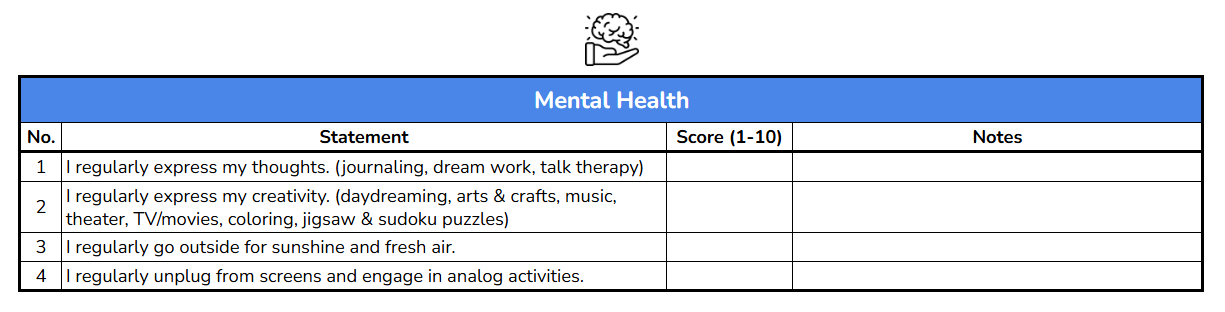
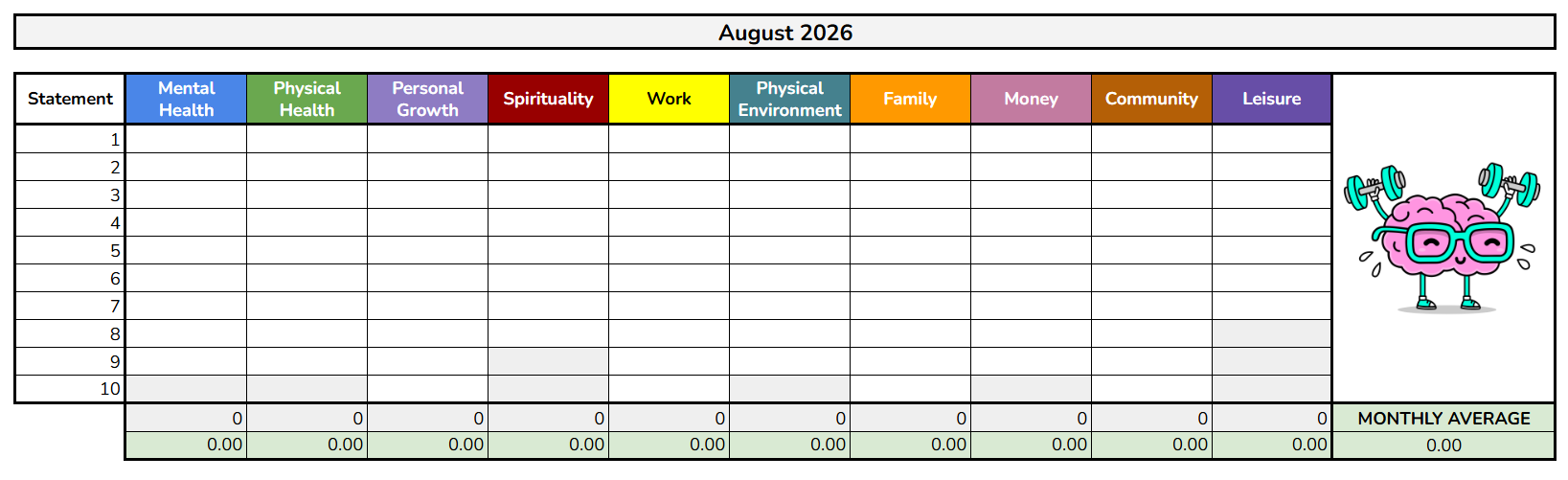
I have seven to ten statements per category; I find that this gives me a well-rounded picture in that particular slice of life. Then I average my scores by category, and then overall, to get an idea of the global impact of the month.
There's an idea that, to have balance, an equal amount of energy should be allotted to each category – or that to be successful, ALL categories should be level 10.
However, different seasons of life mean that different categories of life take precedence.
During the summer, I chase vacation and travel plans. During the winter, I honor my inner Grinch and dedicate as much time to being at home as I can, so I don't burn out from holiday stress. If you're striving for a promotion, raising a newborn, or planning to run a 5K, those goals will mean your time spent will look different – "balance" in life may mean one category outweighs the others, instead of being divided equally.
If you’re in misalignment
If you do a review and find you're in misalignment with your desires, it's important to remember that this review is just data: it's not good or bad, it just means we get to decide how to use it. Beware the word "should" creeping into your assessment. (I should have cooked at home more, I should have done more work on that project, I should have flown to Spain to see the solar eclipse...) If this happens, please stop shoulding on yourself. If you see a gap between where you're at and where you want to be, ask yourself, how can I move the needle 5% toward my desired outcome?
Additionally, changing your approach doesn't necessarily mean JUST DO MORE and TRY HARDER. (For the love of Bob, please don't buy into the toxic positivity approach.) Instead, consider getting creative: habit stack on habits that are already built in; plan to body double once or twice a month with an accountability buddy; find a group or club for the thing you want to do more of; or recalibrate expectations. Instead of "I'm going to walk 30 minutes a day," you could try " I'm going to walk 5 minutes a day" or "I'm going to walk 10 minutes a week/month" and practice committing to small steps.
Celebrate your wins!
Now, for a very important step: CELEBRATE YOUR WINS!
Incremental growth IS progress.
If you have a perfectionist brain like mine, it will tell you that these things are insufficient or irrelevant: trying, failing, backsliding, making plans but not executing. Your inner perfectionist is trying to help you fly FURTHER HIGHER FASTER toward your aspirations. Thank them for their input, then tell them to sit down and eat a cookie.

Now, acknowledge and validate ALL THE THINGS YOU DID in imperfect action. If you met a benchmark or completed a project, CELEBRATE! Decide how you're going to celebrate your win! You could call a friend to update them on progress, and ask them to congratulate you (trust me, all your friends want to help you celebrate – it's okay to ask them to). You could print a photo or display a memento commemorating the event. You could plan a fun dinner out at a new restaurant. Or, if you want to be really cheesy like me, you could give yourself a pep talk in the mirror. (Does anyone else love talking to themselves in the mirror? Just me? Not only am I good company, I'm a great conversationalist.)
From midnights to cups of coffee, or whatever you value, a monthly review can enable insight and empower shifts in the direction we choose to go. This review is meant to serve YOUR needs. Really make it your own.