Remote Job Searching 101
So you wanna work remotely… I get it. The growth of remote work is one of the only positive things to come out of the COVID pandemic, even though companies are trying like hell to convince us all that corporate real estate is going to suffer and die without our butts in office seats.
There’s something to be said for going to the office and seeing your coworkers in person, but some people truly do their best work independently and are an asset to the job as long as they can work in their ideal environment. And maybe that ideal environment is home in your jammies petting your dog while you work.

Why work remotely?
There are benefits for the company and employee when remote work is on the table. For instance:
Better job satisfaction: Flexible schedules are an easy perk to offer, and the payoff comes in the form of reduced turnover because happy employees that are satisfied with their work-life balance are easier to keep happy!
Cost savings: For the employee, reduced commuting and meal costs add up quickly (between $600 to $6,000 per year). And for the company, remote work might mean the organization can downsize their overhead and reduce expenses. Global Workplace Analytics estimates that “a typical U.S. employer can save an average of $11,000 per half-time telecommuter per year.”
Environmental benefit: Instant reduction in the company’s carbon footprint! Reduced commute travel means a reduction in greenhouse gases and emissions from transportation.
DEI benefits of remote work
We at Colorful Futures®️ aren’t scared of diversity, equity, and inclusion because we’re not little bitches.
The disabled community was rightly pissed when remote work took off during the 2020 lockdowns, because it proved something we’ve been saying for years: the infrastructure is there to support remote work. But instead of offering this flexible accommodation to disabled workers, it’s easier to have a no-remote policy and legally nudge those disabled employees out the door.
Hot trash.

Remote work means that people can be gainfully employed even if they can’t handle 40 hours a week in an office—and to be so for real, spending 40 hours a week in an office sucks. Especially for disabled folks who deal with any of the following:
Sensory issues: Lighting, temperature, and noise levels aren’t easily controlled in an office environment. I recall working in an open floorplan office where two of my coworkers would talk on speakerphone to each other, from opposite sides of the room, so I heard every sentence twice—once from the person and once about a second later when their voice came through the other person’s speaker. Out the fuck loud. OMG.
Focus issues: Working in the office is a recipe for distraction. Somebody walks by your desk and asks, “Oh hey, did you see my email?” and then you’re talking about the email, leaving your project forgotten. If you have ADHD, you likely have issues with task switching, or jumping from one task to another. While some people can “multitask” fairly easily, the cognitive burden of trying to remember where you were in one project when the next one interrupts is stressful AF for neuroqueers.
Social issues: Culture fit is a big part of any job, but many neuroqueers (especially autistics) have trouble keeping up with the social culture in the workplace and are seen as standoffish and even rude when they prioritize work over relationships. This issue is less intense when you can work from home and limit the amount of time you have to mask on team calls.
Chronic illness: If your energy changes day to day, you deal with chronic pain or gastro issues, or anything else could befall you at a moment’s notice, working from home is a game changer. You can change your position from sitting at your desk to lying down to sitting on the floor if that’s what your body needs—all without people looking at you weird.
Remote job boards
Our new job board database has a ton of remote-friendly options to explore. Start by selecting a database view organized by location — either a table (scrolling left and right) or a list (scrolling up and down).
Then toggle open the Remote/Anywhere segment, which lists all job boards that have remote positions in alphabetical order.
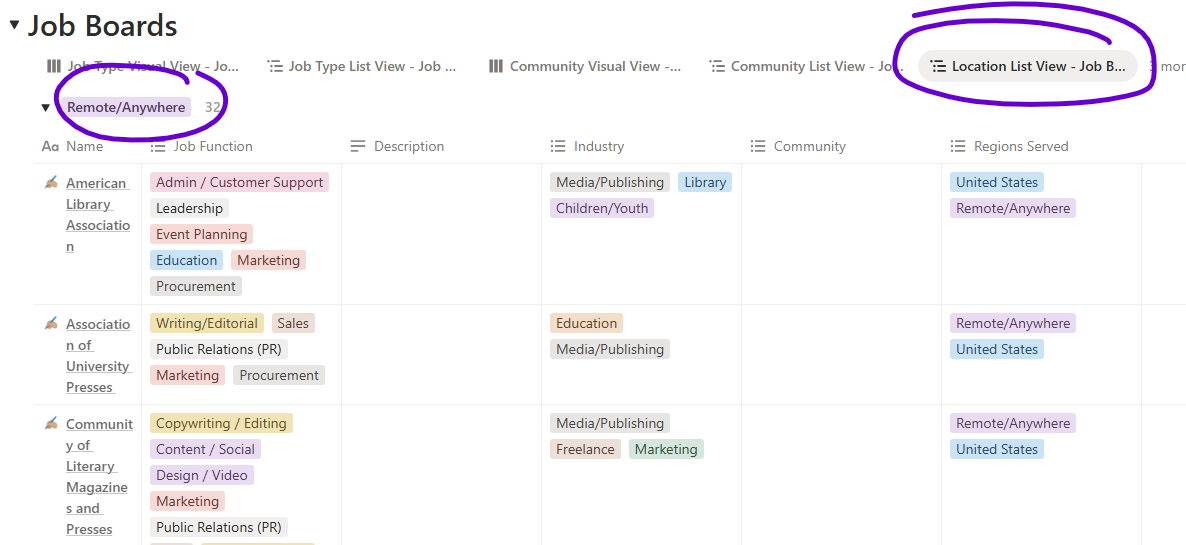
Caveat: This list includes all boards that offer remote roles, but only a handful are remote-only. If you’re sure remote is the only way forward for you, focus on those boards to avoid the frustration of trying to find your remote needle in a haystack of disingenuous postings.
Some of our favorite remote job boards include:
BlackRemoteShe (for Black women)
FlexJobs
Jobicy
No Desk
RemoteWoman (for women)
Spectroomz (autistic-focused job board)
WeWorkRemotely
Working Nomads
WorkWithIndies (indie games)
Landing your remote role
Start with just a few boards that you check regularly, and work out a routine that you can stick to when your energy and focus are a little lacking. We recommend shooting for at least two 1-hour job search sessions a week, split into three 20-minute work sessions.
First 20 minutes: Browse the job boards and open interesting jobs in new tabs.
Second 20 minutes: Review those jobs and make sure they’re good fits.
Last 20 minutes: Submit your application(s).
If you have more energy, do another round. If this is all you can do, stop here. Take breaks between your work sessions and make sure you have a snack and a bathroom break before you begin. You don’t need to be doing the pee-pee dance while you’re trying to navigate to a company’s career page.
Before applying, make sure you fine-tune your resume to focus on your remote skills. As you continue searching these job boards, you might start to notice patterns in the tools, tech, and skills remote roles are looking for. If you have these same skills, include those keywords on your resume in your professional summary or in your experience.
Consider…
Video meeting software like Zoom, Google Meet, Cisco WebEx, GoToMeeting, Microsoft Teams, Slack, Skype, etc.
Project management tools like Airtable, Asana, ClickUp, Notion, xTiles, etc.
Remote keywords including “asynchronous communication,” “distributed team,” “self-management,” and “virtual collaboration”.
You’ll also want to show that you can be an independent worker, especially if you’re applying to a company that isn’t remote-first. Unfortunately, a lot of “traditional” workplaces and managers make the assumption that if you’re not under their direct supervision, you’re not being productive… despite all the evidence to the contrary that workers actually do more work when they have the flexibility to work from home.

Make sure your resume shows off any remote projects you’ve led, such as…
Transitioning your team from in-person to remote in 2020 (and specifics about what infrastructure you helped create to do so)
Delivering an impact report on Microsoft Teams to your whole company
Digitizing technical articles for easy remote access
Anything else you’ve done that shows the skills they’re looking for
Ready to get your remote job? Let us know what other questions you have in the comments, or reach out to schedule a vibe check with one of our 1on1 career coaches!