Finding Freelance Clients Doesn't Have to Be a Chore
When the job market gets you down, know what you gotta do?
Just keep swimming.

A GIF from Finding Nemo. Dory is dancing and chanting “Just keep swimming, just keep swimming!” to a very disgruntled Marlin.
But seriously though, what can you do when the job market absolutely sucks, and the hiring process takes too long, and you can barely remember what job security felt like?
One option is freelancing.
What is freelancing?
Originally, a free lance was a mercenary knight who offered their work to any king or leader who would pay, rather than being tied to one king. The meaning has, obviously, evolved since the early 19th century. Now “freelance” means working for yourself, providing work directly to a client without being employed on that client’s payroll.

A GIF from A Knight’s Tale. Alan Tudyk’s character says “It’s called a lancet, hello!”
Roughly half of freelancers do writing work—freelance writing is an excellent way to build up credibility as a journalist or author by getting bylines in publications, and freelance copywriting is consistently in demand. Other popular areas for freelance work include graphic design, web design and development, marketing, tutoring, and translation services.
According to Upwork’s December 2025 hiring report, demand for freelance operational skills (such as project management, virtual assisting, accounting/bookkeeping, etc.) is up 150%, and the highest growth is happening in small and medium-sized businesses (SMB). Small businesses tend to rely on flexible freelancers to meet their needs without having the overhead of hiring full-time team members.
Also from Upwork’s December 2025 report, the top skills companies are looking for include:
Python
Video editing
Data entry
Virtual admin assistance
Web design
Adobe Photoshop
And also, AI “skills,” which I hate to give any credibility to but will also include in this blog for the sake of accuracy:
ChatGPT (aka theft)
AI-generated video (aka theft)
Machine learning (aka theft)
If you want somebody who will be nice to AI, don’t read my blogs. 🙂
How much should you charge as a freelancer?
It’s all well and good to have some skills people want to pay for… but how do you actually find clients, and how much are you supposed to get paid for your freelance work?
Sometimes freelance gigs have a budget listed, and other times they may ask you for your rates first. It’s a good idea to have a range in mind, or at least a minimum. Don’t get out of bed for less than your minimum!
When calculating your minimum freelance rate, remember that self-employment income is taxed differently and doesn’t have automatic tax withholding. You’ll need to set aside roughly 30% of what you make to pay taxes (give or take business expenses).
If you’re just starting out and you’re pretty financially secure, you can start on the lower end and wing it while you dial in the specifics about how much you need to charge for your time and expertise. But if you’re freelancing to replace full-time income, your calculations should take into account your living expenses, savings goals, and enough money to get yourself a little treat.
Got a monthly number you need to hit? Bump it up a little to account for the 30% set aside for taxes, and then divide by how many hours you want to work per month.
If you need to make $2,000 per month, working 40 hours, you’d need to charge $50 per hour. If you have more time, you can charge less. You’ll also need to factor in the time and energy it takes to do the admin side of freelancing—putting together proposals, following up on invoices, and managing your project notes.
Rates also vary by industry. You might need to drop your rate to be competitive on a basic product copywriting gig because there are so many copywriters, but if your genius is offering branded marketing copy that converts, you can charge more for the specialty and experience.
Basically, it all depends. Sorry there isn’t a clear way forward! (But also, if you want to talk out your pricing with us, a 1on1 intensive with Caitlin or Liora can help you nail these details down in one hour).
Freelance gig databases
Within our job board database, we have identified several job boards and communities dedicated to helping you find freelance work!
Start by navigating to the section labeled Contract/Freelance. In this segment of the database, you’ll only see job boards that list contract positions.
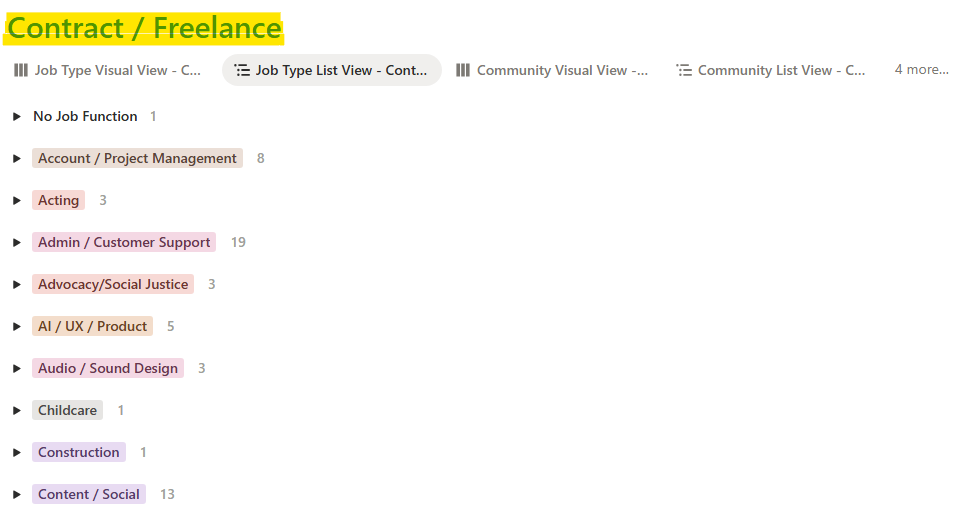
A screenshot of the Job Type view, with the Marketing segment toggled open. Two job boards are displayed, American Library Association and Association of University Presses.
Industry indicates the overall industry areas the job boards cover. Some of our recommended job boards are specifically for tech jobs, for example, or media/publishing. If you are committed to finding work in a particular industry, this view can help you look at your options.

A screenshot of the Industry view, with the Technology segment toggled open. One job board is displayed, Spectroomz.
To find a potential freelance role within a certain demographic or community, use the Community view. In this view you’ll see job boards listed for BIPOC, Disabled/Neurodivergent, LGBTQ+, and Women.
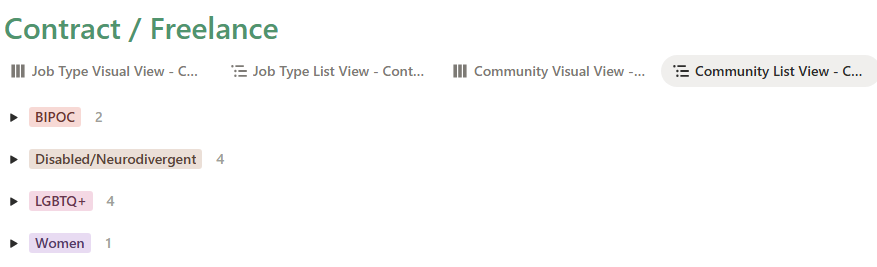
A screenshot of the Community view, showing the four demographic areas to see job boards specifically serving BIPOC, Disabled/Neurodivergent, LGPTQ+, and Women job seekers.
Finally, the Location view segments job boards based on their location—namely, remote vs. in-person. Your best bet for finding a remote-based contract role is to toggle open the Remote/Anywhere list.

A screenshot of the Location view, with the “Remote/Anywhere” toggle highlighted.
Other considerations for freelancing
There are tons of opportunities to find freelance gigs, from small assignments to longer-term contracts. Try searching LinkedIn for “contract” or “freelance” in your main feed. Sometimes you can find short-term contracts in posts rather than seeing them listed on the job board. You can also take the initiative to post on LinkedIn about the type of freelance work you’re looking for, and your contacts there may know someone in need of your services.
Keep in mind that most freelance jobs don’t withhold taxes from your pay! If you freelance to supplement traditional employment income, you likely don’t need to worry much about this, because your employer is already withholding taxes on your behalf. But if you start to bring in significant income from your contract work, it’s worth talking to a tax pro to determine whether or not you should pay quarterly tax estimates.
Need to talk it out? Liora and Caitlin have openings for Entrepreneur Intensives! In one 50-minute session, we’ll focus on your freelance strategy and answer all the questions outlined in this article. Our books are only open for two weeks this July, so move fast!